Enterprise RAG: Build a Knowledge Assistant That Respects Access
TL;DR: Enterprise RAG is a retrieval-augmented generation architecture that supplies an AI model with relevant, authorised company information when answering a question. Select a governed document collection and identify its owner. RAG does not remove hallucination; the application still needs evaluation, abstention and source-quality controls.
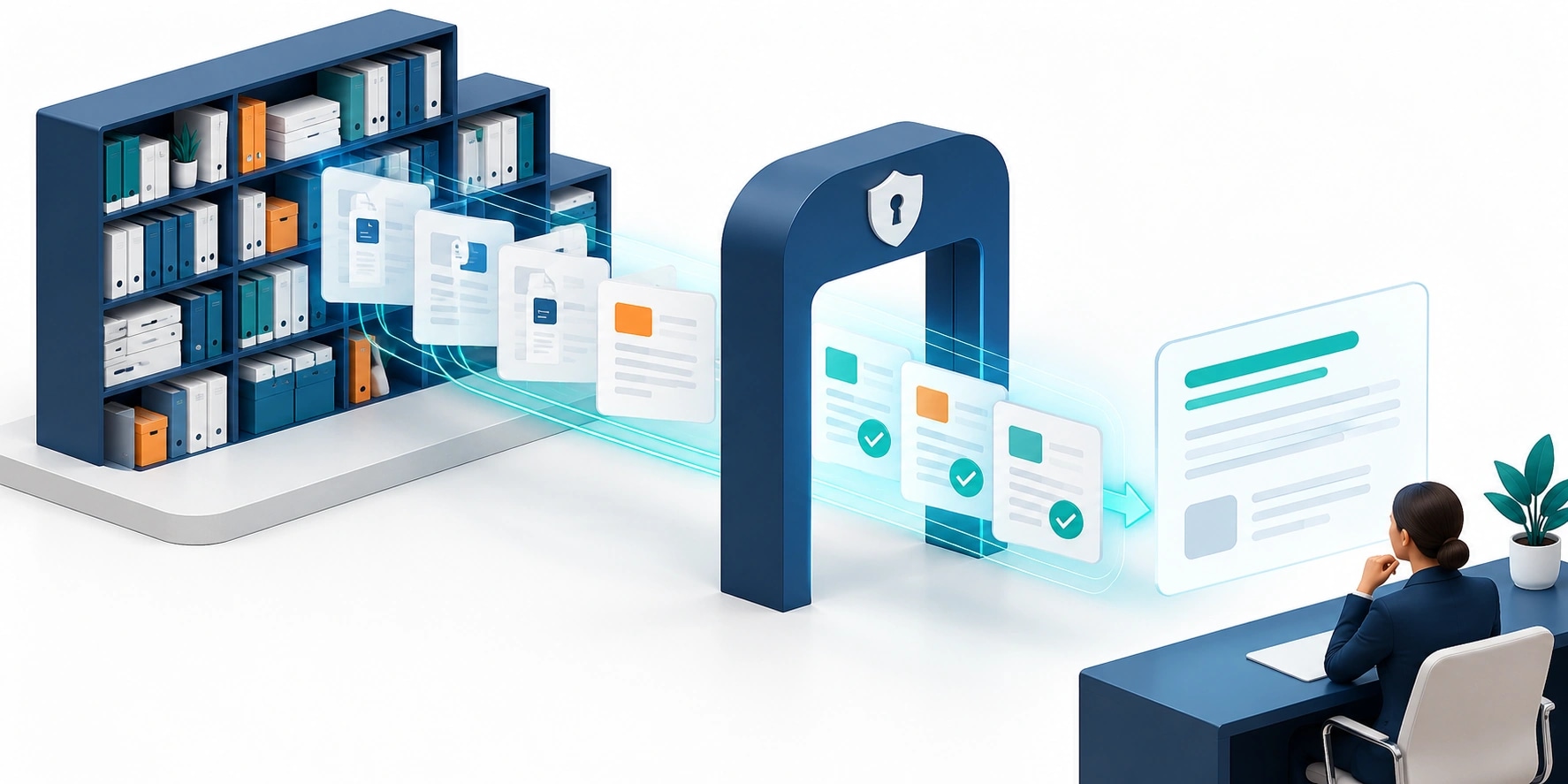
Original AI-generated editorial illustration; it depicts a concept rather than a client deployment or product screenshot.
Introduction
Employees often know that an answer exists somewhere, but not which document is current or whether it applies to their team. A company knowledge assistant should shorten that search while preserving the boundaries already attached to company information. A convincing answer with the wrong policy behind it creates more work. Here is how to evaluate enterprise RAG against that business need.
What Is enterprise RAG?
Enterprise RAG is a retrieval-augmented generation architecture that supplies an AI model with relevant, authorised company information when answering a question.
Document collections contain outdated and contradictory material. Different employees are entitled to different information. Answers need sources that a reader can inspect and challenge.
RAG does not remove hallucination; the application still needs evaluation, abstention and source-quality controls. The scope should make this distinction clear before the team commits to a solution.
Technical context: Microsoft describes RAG as grounding model responses in proprietary content. Microsoft: Retrieval-augmented generation overview
Why enterprise RAG Matters
- Document collections contain outdated and contradictory material.
- Different employees are entitled to different information.
- Answers need sources that a reader can inspect and challenge.
How to Evaluate and Implement enterprise RAG
Prepare the corpus before the chat window
Start with a small collection owned by people who can maintain it. Record document identifiers, versions, effective dates and permission groups. Remove duplicates and agree how superseded policies will be handled. Break material into passages that retain headings, tables and exceptions. A chunk without its parent policy or applicability dates can be technically retrievable and still be misleading. Content preparation is an ongoing operating responsibility.
Retrieve under the user's permissions
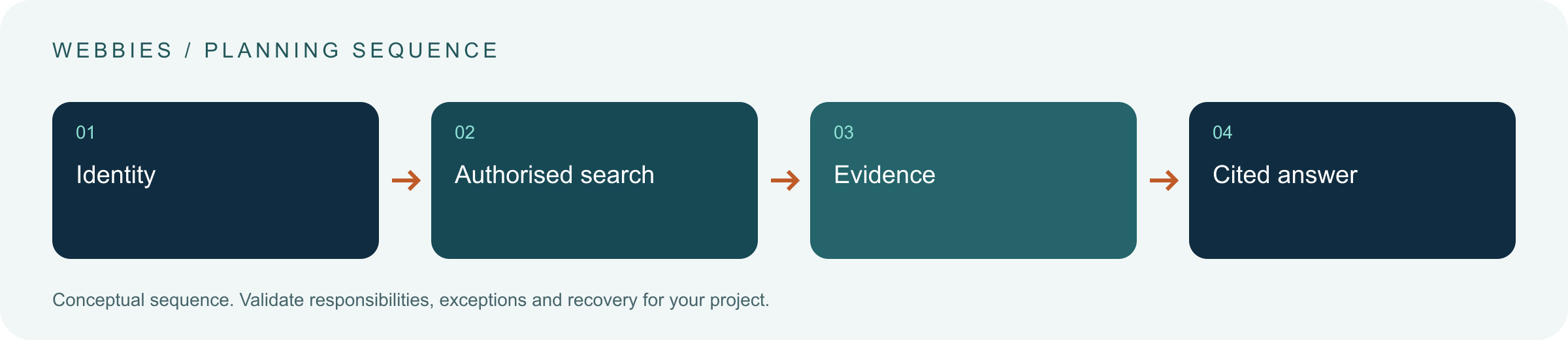
Resolve the user's identity before search, then enforce access restrictions in the retrieval layer. Do not retrieve confidential passages and rely on a prompt to hide them. Combine exact identifiers with semantic retrieval where the collection needs both. A product code, a policy number and a broad procedural question require different search behaviour. Log which evidence was available so a poor answer can be traced to retrieval or synthesis.
Make uncertainty part of the answer
Require the answer to distinguish supported statements from missing evidence. Link the relevant passage, show an effective date where useful and offer a handoff when sources conflict. Evaluate questions with no answer in the collection; refusal is a correct outcome in those cases. Also test whether an employee can infer a restricted document through summaries or follow-up questions. Citation presence alone does not establish citation correctness.
Compare the available approaches
| Approach | Suitable starting point | Main limitation or responsibility |
|---|---|---|
| Keyword search | Known names and document codes | User must assemble the answer |
| Semantic search | Questions using different vocabulary | Similar text may be inapplicable |
| RAG assistant | Answers assembled from retrieved passages | Evidence and permissions need testing |
A practical example
Imagine a multi-branch business creating an assistant for returns procedures. Store staff can access store-level policies, while finance-only settlement guidance remains restricted. When asked about an unusual damaged return, the assistant retrieves the current policy and highlights the approval exception. If a branch-specific memo contradicts the central document, it asks for a policy owner rather than selecting whichever passage sounds strongest. The example is illustrative, not a reported Webbies deployment.
An acceptance test worth running
Ask the same policy question as two users with different access groups. Each should receive only evidence available to that identity. Remove a previously accessible document and repeat the test after the agreed update interval. Check that cached passages, citations and follow-up answers do not continue exposing the withdrawn information. Include a question for which the collection has no supported answer.
What to measure
Measure retrieval coverage, supported-answer accuracy, restricted-information exposure, citation correctness and time to find an actionable answer.
Use a representative baseline and record the conditions of the comparison. Agree who reviews failures and what evidence is needed before expanding the scope. For a broader view of the related delivery work, explore Webbies services.
Practical Steps for enterprise RAG
- Select a governed document collection and identify its owner.
- Record identity, version and permission metadata during ingestion.
- Create questions covering ordinary, missing, restricted and conflicting information.
- Review citations and permissions before inviting a wider employee group.
Prepare a useful project brief
| Decision | What to establish |
|---|---|
| Audience | IT leaders planning internal document assistants |
| First boundary to agree | Select a governed document collection and identify its owner. |
| Evidence of useful performance | Measure retrieval coverage, supported-answer accuracy, restricted-information exposure, citation correctness and time to find an actionable answer. |
| Estimate dependency | Scanned files, complex permissions, frequent policy changes and disconnected repositories increase preparation and maintenance work. |
Bring sample inputs and an example of an exception to the first discussion. Separate confirmed requirements from assumptions, and identify who can supply missing information. The brief should let a delivery team explain what it needs to investigate before making a detailed commitment.
Common Mistakes to Avoid
- Indexing every shared drive before defining ownership.
- Using source links that employees cannot open.
- Measuring answer fluency while ignoring evidence correctness.
Frequently Asked Questions
What does enterprise RAG mean in a business project?
Enterprise RAG is a retrieval-augmented generation architecture that supplies an AI model with relevant, authorised company information when answering a question.
How should a team begin evaluating company knowledge assistant?
Select a governed document collection and identify its owner. Record identity, version and permission metadata during ingestion.
How do we measure whether permission-aware search is useful?
Measure retrieval coverage, supported-answer accuracy, restricted-information exposure, citation correctness and time to find an actionable answer.
What affects the cost or timeline of enterprise RAG?
Scanned files, complex permissions, frequent policy changes and disconnected repositories increase preparation and maintenance work. A delivery estimate should follow a review of these dependencies.
What is a common misconception about enterprise RAG?
RAG does not remove hallucination; the application still needs evaluation, abstention and source-quality controls.
Conclusion
A knowledge assistant earns trust through current evidence and enforced access. Build the governed information path before expanding the conversational experience. Plan a company knowledge-assistant assessment with Webbies.
Sources and further reading
- Microsoft: Retrieval-augmented generation overview — primary technical reference, checked during research on 30 October 2026.
Discuss your project
Plan a company knowledge-assistant assessment. Share the current workflow, intended users, existing systems and the decision you need to make; the next step can be a 20–30 minute discovery discussion.