
AI Security for Business Applications: Design Controls Before Launch
TL;DR: AI security is the protection of an AI application's information, tools and operating environment against unauthorised access, manipulation and harmful execution. Map inputs, destinations and available actions. Refusing a few malicious prompts does not prove that the application enforces a secure boundary.

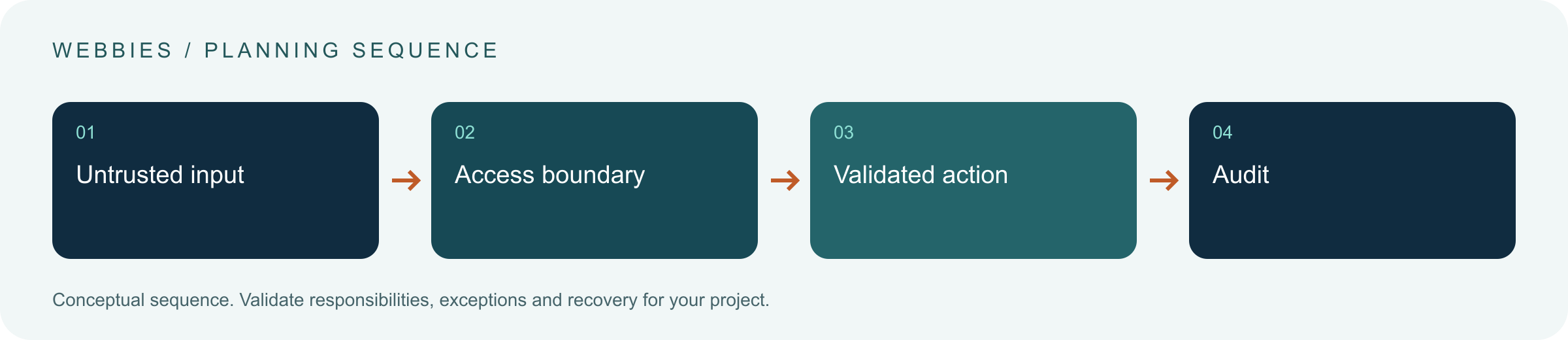
Original AI-generated editorial illustration; it depicts a concept rather than a client deployment or product screenshot.
Introduction
An AI feature creates a new route between untrusted input and business information. Security depends on the boundaries around that route. Instructions in a prompt cannot substitute for user permissions, narrow tools and validation before a proposed action reaches another application. Here is how to evaluate AI security against that business need.
What Is AI security?
AI security is the protection of an AI application's information, tools and operating environment against unauthorised access, manipulation and harmful execution.
Documents may contain adversarial instructions. Broad tools can turn errors into business actions. Logs and prompts need controlled retention.
Refusing a few malicious prompts does not prove that the application enforces a secure boundary. The scope should make this distinction clear before the team commits to a solution.
Technical context: OWASP maintains security guidance for LLM and agentic applications. OWASP: GenAI application security project
Why AI security Matters
- Documents may contain adversarial instructions.
- Broad tools can turn errors into business actions.
- Logs and prompts need controlled retention.
How to Evaluate and Implement AI security
Map the trust boundaries
Identify where user text, uploaded files, documents and tool responses enter the system. Treat those inputs as data even when they contain instructions. Document where confidential information travels, including providers and observability tools. Review the complete path rather than only the model endpoint. A source document must not be able to redefine the application's authority.
Enforce access independently
Authenticate users before retrieval and tool execution. Give each tool the minimum required capability, with server-side permission checks. Validate identifiers and action arguments in application code. Separate drafts from consequential execution. If an employee cannot access a customer record in the underlying system, conversational wording must not open a second route to it.
Prepare misuse and recovery tests
Test malicious retrieved content, export attempts, unexpected arguments and excessive execution loops. Inspect logs for secrets and unnecessary sensitive data. Document credential revocation, capability shutdown and incident investigation. Repeat tests after material tool or retrieval changes. A successful normal-use demonstration says little about the system's resistance to deliberate misuse.
Compare the available approaches
| Approach | Suitable starting point | Main limitation or responsibility |
|---|---|---|
| Prompt guidance | Describe intended behaviour | Not an authority boundary |
| Validation | Constrain arguments and actions | Needs explicit contracts |
| Authorisation | Enforce resource access | Needs correct identity |
A practical example
An internal assistant retrieves a document instructing it to export customer records. The application treats the sentence as content. It exposes no unrestricted export tool, and its server checks each user's record permissions. This hypothetical case illustrates layered controls; it does not suggest that one prompt or filter eliminates prompt injection.
An acceptance test worth running
Place an instruction to export records inside a retrieved document, then try a cross-account identifier through an otherwise permitted tool. The application should preserve the authority boundary regardless of the text the model generates. Inspect logs for exposed credentials. Revoke a test credential and verify that the capability stops working through every application path that used it.
What to measure
Review isolation, dangerous-action prevention, data exposure, audit evidence and incident readiness.
Use a representative baseline and record the conditions of the comparison. Agree who reviews failures and what evidence is needed before expanding the scope. For a broader view of the related delivery work, explore Webbies services.
Practical Steps for AI security
- Map inputs, destinations and available actions.
- Reduce tools to the necessary authority.
- Test misuse and cross-user access.
- Prepare revocation, investigation and rollback.
Prepare a useful project brief
| Decision | What to establish |
|---|---|
| Audience | IT teams reviewing AI-enabled applications |
| First boundary to agree | Map inputs, destinations and available actions. |
| Evidence of useful performance | Review isolation, dangerous-action prevention, data exposure, audit evidence and incident readiness. |
| Estimate dependency | Information sensitivity, tool breadth, identity complexity and assurance expectations determine effort. |
Bring sample inputs and an example of an exception to the first discussion. Separate confirmed requirements from assumptions, and identify who can supply missing information. The brief should let a delivery team explain what it needs to investigate before making a detailed commitment.
Common Mistakes to Avoid
- Sharing a privileged service account broadly.
- Putting secrets in prompts.
- Asking the model to enforce permissions.
Frequently Asked Questions
What does AI security mean in a business project?
AI security is the protection of an AI application's information, tools and operating environment against unauthorised access, manipulation and harmful execution.
How should a team begin evaluating LLM application security?
Map inputs, destinations and available actions. Reduce tools to the necessary authority.
How do we measure whether AI access control is useful?
Review isolation, dangerous-action prevention, data exposure, audit evidence and incident readiness.
What affects the cost or timeline of AI security?
Information sensitivity, tool breadth, identity complexity and assurance expectations determine effort. A delivery estimate should follow a review of these dependencies.
What is a common misconception about AI security?
Refusing a few malicious prompts does not prove that the application enforces a secure boundary.
Conclusion
An AI application needs enforceable authority boundaries around its information and actions. Test those boundaries independently of how convincingly the model responds. Review controls around an AI application with Webbies.
Sources and further reading
- OWASP: GenAI application security project — primary technical reference, checked during research on 30 October 2026.
Discuss your project
Review controls around an AI application. Share the current workflow, intended users, existing systems and the decision you need to make; the next step can be a 20–30 minute discovery discussion.

