Software Development Partner: A Practical Due-Diligence Checklist
TL;DR: A software development partner is an external team that shares responsibility for designing, delivering and maintaining an agreed software outcome with a client organisation. Prepare an outcome-focused brief and known constraints. The lowest initial quote is not necessarily the lowest ownership cost once omitted work and support are included.

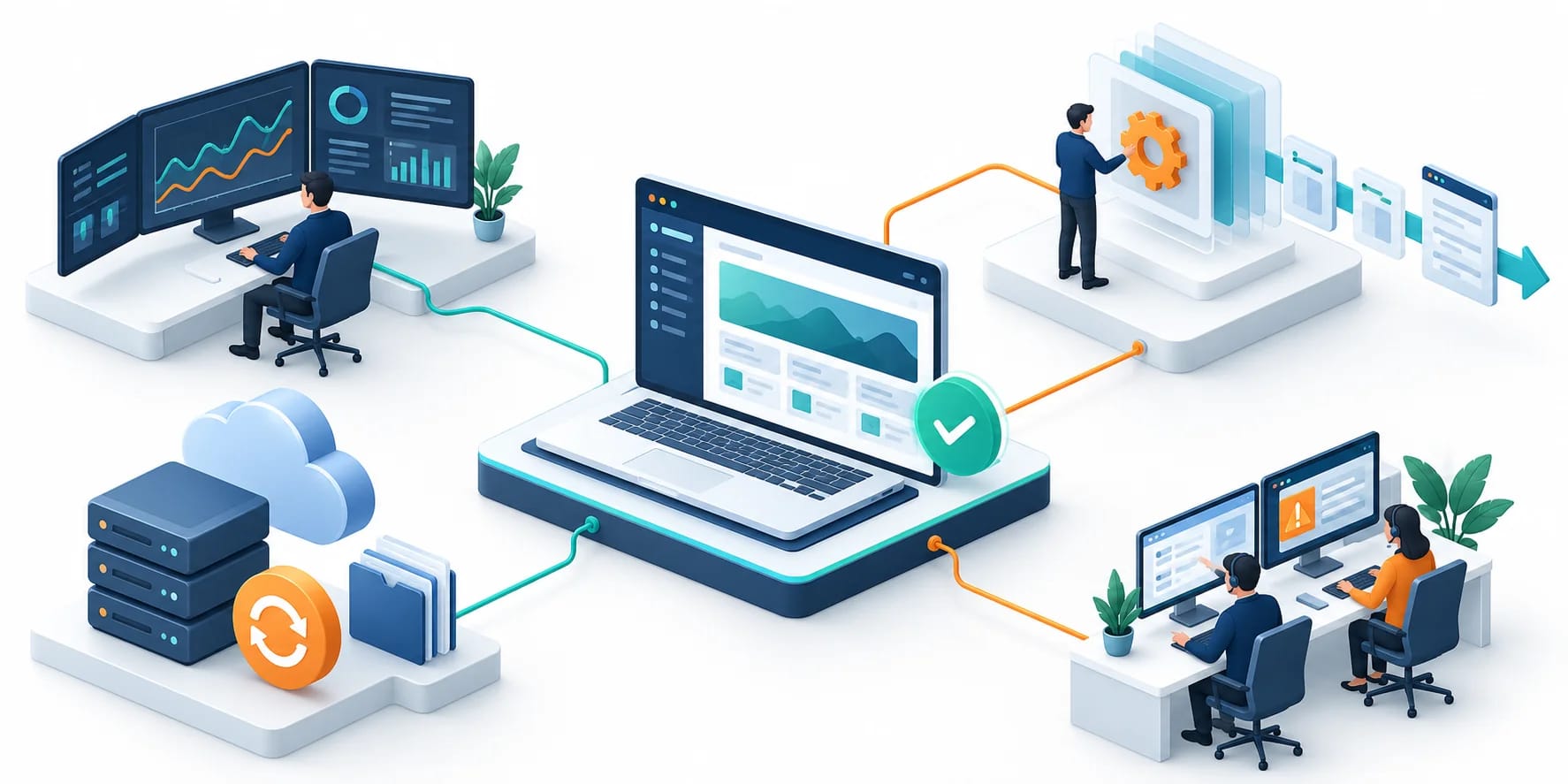
Original AI-generated editorial illustration; it depicts a concept rather than a client deployment or product screenshot.
Introduction
A proposal can sound comprehensive while leaving data migration, acceptance and post-launch support undefined. Partner selection should make those responsibilities inspectable. Compare how each team would reduce uncertainty and prove completion, rather than relying on promises of innovation or an impressive list of technologies. Here is how to evaluate software development partner against that business need.
What Is software development partner?
A software development partner is an external team that shares responsibility for designing, delivering and maintaining an agreed software outcome with a client organisation.
A broad capability list may conceal delivery assumptions. Unclear acceptance creates avoidable disputes. Access and maintenance decisions affect future independence.
The lowest initial quote is not necessarily the lowest ownership cost once omitted work and support are included. The scope should make this distinction clear before the team commits to a solution.
Technical context: The Service Manual frames discovery around understanding the problem before committing to a build. GOV.UK: How discovery works
Why software development partner Matters
- A broad capability list may conceal delivery assumptions.
- Unclear acceptance creates avoidable disputes.
- Access and maintenance decisions affect future independence.
How to Evaluate and Implement software development partner
Evaluate the work behind the proposal
Ask the team to explain a relevant workflow, likely risks and the information it needs before estimating. Request approved examples with clear project status and scope. Distinguish a partner-led engagement from staff augmentation if responsibility for delivery matters. Identify the people assigned to discovery, architecture, implementation and support. Sales confidence is not a substitute for a coherent delivery model.
Make deliverables and acceptance concrete
Define outputs such as reviewed workflows, prototypes, integration contracts and tested releases. Agree the client's responsibilities for decisions, data and access. Record assumptions and exclusions. Compare proposals against the same scope rather than headline prices. Changes should have a clear impact-review process, but that process must not become a substitute for investigating known uncertainty before the build.
Preserve ownership and continuity
Clarify code and design access, intellectual-property terms, infrastructure accounts and third-party dependencies through the appropriate commercial review. Ask how another competent team could take over. Define documentation, backups, incident response and maintenance responsibilities. A dependable partnership makes its work understandable and recoverable. It should not depend on a single person's undocumented access or knowledge.
Compare the available approaches
| Approach | Suitable starting point | Main limitation or responsibility |
|---|---|---|
| Screen-based estimate | Early interface scope | Can miss business and integration work |
| Discovery-led proposal | Resolved assumptions and boundaries | Needs useful discovery deliverables |
| Retained partnership | Ongoing improvement and support | Needs prioritisation and accountability |
A practical example
A hypothetical business compares two portal proposals. One offers many screens but omits migration and ERP acceptance. The other begins with discovery outputs and identifies the unresolved interface contract. The buyer normalises scope before comparing price and reviews access and support terms. The example illustrates due diligence without claiming that one commercial model is always superior.
An acceptance test worth running
Normalise competing proposals into one deliverable and responsibility matrix. Ask a competent third party whether the acceptance criteria establish completion and whether handover information supports continuity. Include the client's own decisions and access obligations. Any unresolved assumption affecting price or delivery should be visible before selection, rather than surfacing later as a disputed omission.
What to measure
Assess requirement clarity, accepted deliverables, change transparency, accessible evidence and continuity readiness.
Use a representative baseline and record the conditions of the comparison. Agree who reviews failures and what evidence is needed before expanding the scope. For a broader view of the related delivery work, explore Webbies services.
Practical Steps for software development partner
- Prepare an outcome-focused brief and known constraints.
- Review relevant evidence and the actual delivery team.
- Normalise deliverables, acceptance and exclusions.
- Agree access, continuity and post-release ownership.
Prepare a useful project brief
| Decision | What to establish |
|---|---|
| Audience | business buyers selecting a long-term engineering partner |
| First boundary to agree | Prepare an outcome-focused brief and known constraints. |
| Evidence of useful performance | Assess requirement clarity, accepted deliverables, change transparency, accessible evidence and continuity readiness. |
| Estimate dependency | A meaningful comparison needs equivalent scope, delivery responsibility, commercial terms and support expectations. |
Bring sample inputs and an example of an exception to the first discussion. Separate confirmed requirements from assumptions, and identify who can supply missing information. The brief should let a delivery team explain what it needs to investigate before making a detailed commitment.
Common Mistakes to Avoid
- Comparing quotes with different assumptions.
- Accepting unverifiable outcomes or testimonials.
- Leaving code and infrastructure access until handover.
Frequently Asked Questions
What does software development partner mean in a business project?
A software development partner is an external team that shares responsibility for designing, delivering and maintaining an agreed software outcome with a client organisation.
How should a team begin evaluating software vendor due diligence?
Prepare an outcome-focused brief and known constraints. Review relevant evidence and the actual delivery team.
How do we measure whether technology partner selection is useful?
Assess requirement clarity, accepted deliverables, change transparency, accessible evidence and continuity readiness.
What affects the cost or timeline of software development partner?
A meaningful comparison needs equivalent scope, delivery responsibility, commercial terms and support expectations. A delivery estimate should follow a review of these dependencies.
What is a common misconception about software development partner?
The lowest initial quote is not necessarily the lowest ownership cost once omitted work and support are included.
Conclusion
Choose a software partner on comparable scope, verified capability and continuity. Make acceptance and access concrete before the business commits to delivery. Start a technology-partner discovery discussion with Webbies.
Sources and further reading
- GOV.UK: How discovery works — primary technical reference, checked during research on 30 October 2026.
Discuss your project
Start a technology-partner discovery discussion. Share the current workflow, intended users, existing systems and the decision you need to make; the next step can be a 20–30 minute discovery discussion.