
RAG vs Fine-Tuning: How to Choose for Business AI
TL;DR: RAG vs fine-tuning is a choice between retrieving external information at answer time and adapting a model's behaviour using training examples. Classify current failures as knowledge, behaviour or application errors. Fine-tuning is not a reliable replacement for a live database or a permission-aware document search system.

Original AI-generated editorial illustration; it depicts a concept rather than a client deployment or product screenshot.
Introduction
A business asks for a model trained on its documents when it may actually need a search layer. Another team adds retrieval when its real problem is inconsistent output formatting. These are different requirements. Choosing the right approach starts with identifying what the system gets wrong and how often the underlying information changes. Here is how to evaluate RAG vs fine-tuning against that business need.
What Is RAG vs fine-tuning?
RAG vs fine-tuning is a choice between retrieving external information at answer time and adapting a model's behaviour using training examples.
Changing business facts need a dependable update path. Training examples and reference documents serve different purposes. The wrong approach can add cost without solving the observed failure.
Fine-tuning is not a reliable replacement for a live database or a permission-aware document search system. The scope should make this distinction clear before the team commits to a solution.
Technical context: Microsoft describes RAG as grounding model responses in proprietary content. Microsoft: Retrieval-augmented generation overview
Why RAG vs fine-tuning Matters
- Changing business facts need a dependable update path.
- Training examples and reference documents serve different purposes.
- The wrong approach can add cost without solving the observed failure.
How to Evaluate and Implement RAG vs fine-tuning
Separate knowledge from behaviour
Ask whether the model lacks a fact or fails to perform a task consistently. A current warranty policy is reference information. Producing a required classification scheme is behaviour. Retrieval can make an approved document available without teaching the model to reproduce it from memory. Fine-tuning can be considered when well-designed prompts and representative examples still fail to produce the desired task performance. Neither decision should be made from a single impressive response.
Test simpler approaches first
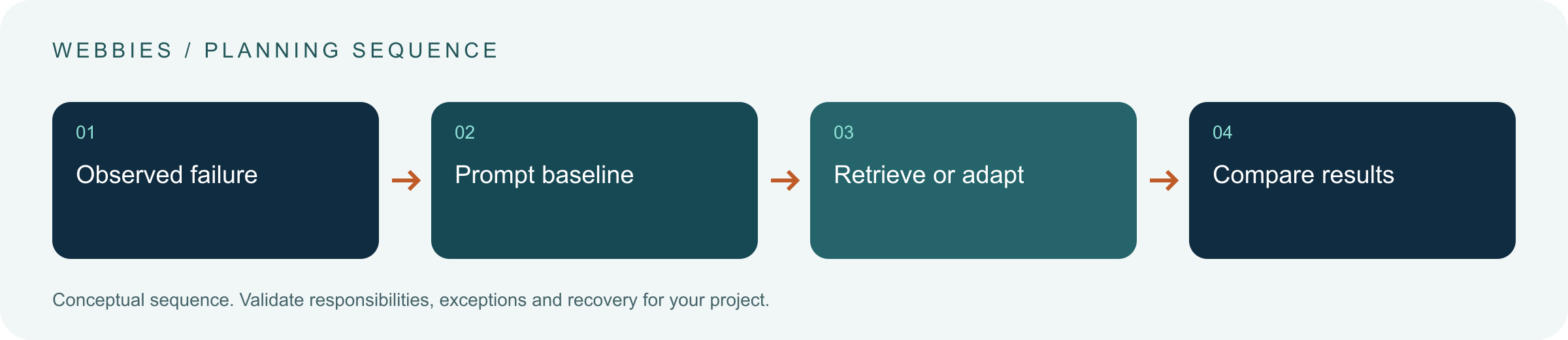
Establish a prompt-only baseline using clear instructions and a small evaluation set. Add retrieval when answers depend on external or changing material. Consider fine-tuning only with suitable examples, a measurable target and a plan for keeping the evaluation independent from training. Compare the complete application, including retrieval latency, model usage, data preparation and human correction. A more customised model is not inherently a more suitable business system.
Plan for a combined architecture
A specialised output task may benefit from adapted behaviour while still retrieving current facts. Keep document permissions and data retention outside model behaviour. A tuned model does not become an access-control system, and retrieved passages do not guarantee a valid structured response. Preserve separate tests for source selection, output validity and final task correctness. This makes it possible to identify which layer needs improvement when the result is wrong.
Compare the available approaches
| Approach | Suitable starting point | Main limitation or responsibility |
|---|---|---|
| Prompting | Clear instructions and a manageable task | Limited examples may miss edge cases |
| RAG | Current reference material and source links | Retrieval quality and access control |
| Fine-tuning | Repeatable behavioural adaptation | Curated examples and retraining lifecycle |
A practical example
A hypothetical product distributor needs answers about stock policies and extraction of purchase-order lines. Retrieval is a natural candidate for changing policy documents. Structured prompting may be enough for the extraction task; fine-tuning becomes a later experiment if consistent errors remain and labelled examples are available. The team should not train confidential price lists into a model as a substitute for retrieving account-authorised pricing from a business system.
An acceptance test worth running
Give the candidate approaches the same unseen question about a newly changed policy. Check whether the answer uses the current source, whether the output follows the required format and how the update reached the system. A behavioural improvement should not conceal stale facts. Preserve the prompt-only baseline so the team can show which added complexity solved which observed failure.
What to measure
Compare task accuracy, evidence support, output validity, update effort and total operating cost under the same test conditions.
Use a representative baseline and record the conditions of the comparison. Agree who reviews failures and what evidence is needed before expanding the scope. For a broader view of the related delivery work, explore Webbies services.
Practical Steps for RAG vs fine-tuning
- Classify current failures as knowledge, behaviour or application errors.
- Build an evaluation set that includes difficult and unseen cases.
- Compare a prompt baseline with retrieval or tuning only where justified.
- Choose the least complex option that meets the agreed acceptance criteria.
Prepare a useful project brief
| Decision | What to establish |
|---|---|
| Audience | technology buyers choosing a custom AI approach |
| First boundary to agree | Classify current failures as knowledge, behaviour or application errors. |
| Evidence of useful performance | Compare task accuracy, evidence support, output validity, update effort and total operating cost under the same test conditions. |
| Estimate dependency | Fine-tuning needs labelled examples and lifecycle management; retrieval needs ingestion, indexing and document governance. |
Bring sample inputs and an example of an exception to the first discussion. Separate confirmed requirements from assumptions, and identify who can supply missing information. The brief should let a delivery team explain what it needs to investigate before making a detailed commitment.
Common Mistakes to Avoid
- Treating a document folder as a ready-made training dataset.
- Putting evaluation examples into training data.
- Expecting either approach to enforce user permissions.
Frequently Asked Questions
What does RAG vs fine-tuning mean in a business project?
RAG vs fine-tuning is a choice between retrieving external information at answer time and adapting a model's behaviour using training examples.
How should a team begin evaluating retrieval augmented generation?
Classify current failures as knowledge, behaviour or application errors. Build an evaluation set that includes difficult and unseen cases.
How do we measure whether business model customization is useful?
Compare task accuracy, evidence support, output validity, update effort and total operating cost under the same test conditions.
What affects the cost or timeline of RAG vs fine-tuning?
Fine-tuning needs labelled examples and lifecycle management; retrieval needs ingestion, indexing and document governance. A delivery estimate should follow a review of these dependencies.
What is a common misconception about RAG vs fine-tuning?
Fine-tuning is not a reliable replacement for a live database or a permission-aware document search system.
Conclusion
Choose retrieval for the knowledge problem and adaptation for the behavioural problem. Keep the simplest baseline that meets the task's acceptance criteria. Review the right architecture for your AI use case with Webbies.
Sources and further reading
- Microsoft: Retrieval-augmented generation overview — primary technical reference, checked during research on 30 October 2026.
Discuss your project
Review the right architecture for your AI use case. Share the current workflow, intended users, existing systems and the decision you need to make; the next step can be a 20–30 minute discovery discussion.