
Agentic Commerce: Prepare Product Data and Checkout Workflows
TL;DR: Agentic commerce uses AI agents to assist with product discovery or shopping actions through structured product information and supported transactional interfaces. Audit identifiers, variant data and market-specific facts. Agentic commerce does not eliminate the need for a clear storefront, accurate product data or dependable customer support.

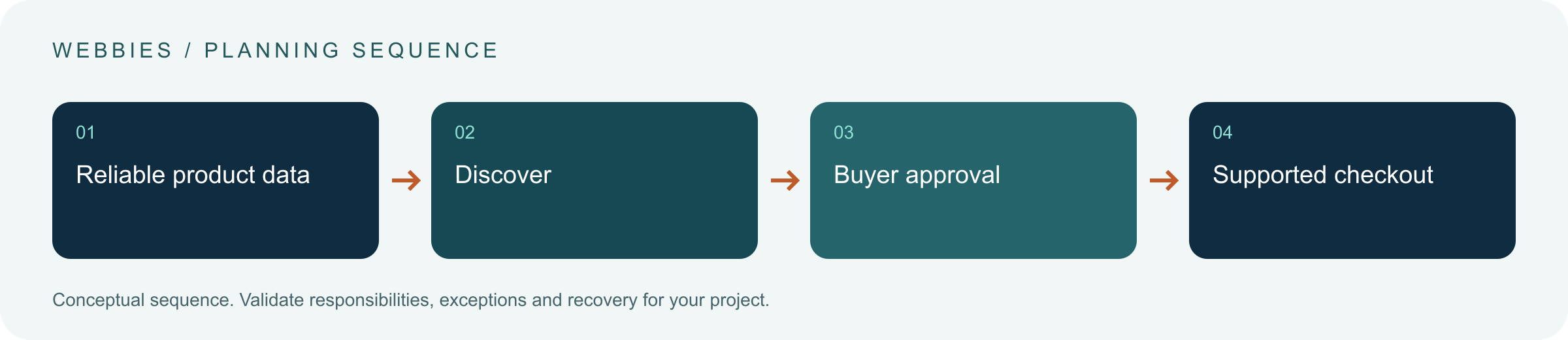
Original AI-generated editorial illustration; it depicts a concept rather than a client deployment or product screenshot.
Introduction
Shopping assistants need dependable product facts and transaction boundaries. Attractive descriptions alone do not tell an agent which variant is available, what the price includes or whether the buyer has approved checkout. Begin with reliable catalogue and order foundations before adding an autonomous shopping experience. Here is how to evaluate agentic commerce against that business need.
What Is agentic commerce?
Agentic commerce uses AI agents to assist with product discovery or shopping actions through structured product information and supported transactional interfaces.
Agents need unambiguous variants, prices and availability. Payment and order actions require buyer authority. New commerce interfaces do not remove existing fulfilment obligations.
Agentic commerce does not eliminate the need for a clear storefront, accurate product data or dependable customer support. The scope should make this distinction clear before the team commits to a solution.
Technical context: Shopify's October 2026 announcement describes product search, carts and Shop Pay checkout through Shop MCP. Shopify: Shop MCP announcement, 13 October 2026
Why agentic commerce Matters
- Agents need unambiguous variants, prices and availability.
- Payment and order actions require buyer authority.
- New commerce interfaces do not remove existing fulfilment obligations.
How to Evaluate and Implement agentic commerce
Make product facts machine-usable
Maintain identifiers, variant relationships, dimensions and applicable commercial information. Keep availability and price tied to the correct market and buyer context. Distinguish factual specifications from promotional descriptions. An agent that cannot tell two similar variants apart may select the wrong product even if the text sounds relevant. Improve the catalogue's normal customer experience alongside its machine-readable representations.
Keep transaction authority explicit
Separate discovery, cart building and purchase confirmation. Explain the total, selected variants, delivery details and relevant conditions before a consequential action. Use the platform's supported interfaces instead of scraping a fragile checkout flow. Preserve the buyer's approved intent and the resulting receipt. A natural-language request to compare products should not be interpreted as unrestricted authority to spend.
Treat new channels as measurable experiments
Verify capability availability, regions, access requirements and supported operations against current documentation. Start with discovery or approved cart preparation when it suits the business. Track variant accuracy, failed handoffs and confirmed orders. Keep ordinary browsing and support routes available. Vendor announcements establish that a capability exists; they do not prove that it is suitable for every merchant or that it improves sales.
Compare the available approaches
| Approach | Suitable starting point | Main limitation or responsibility |
|---|---|---|
| AI-assisted discovery | Compare and explain products | Needs reliable catalogue facts |
| Cart preparation | Assemble a proposed purchase | Needs variant and price validation |
| Transactional agent | Execute supported shopping actions | Needs explicit authority and receipts |
A practical example
A hypothetical home-products store prepares structured catalogue data and tests an assistant that assembles a shortlist. It can prepare a cart, but the buyer reviews variants, totals and delivery information before checkout. Incorrect or missing product facts are corrected in the source catalogue. The first experiment measures selection and handoff quality rather than claiming an immediate revenue benefit from a new channel.
An acceptance test worth running
Ask an assistant to compare two similar variants, then change price or availability before checkout. The supported interface should revalidate the purchase and present the updated proposal for approval. A request to compare must not become permission to buy. Inspect the cart, transaction receipt and handoff to fulfilment separately, including when the agent loses connection before receiving confirmation.
What to measure
Track correct variants, usable shortlists, checkout handoff errors and verified orders rather than assistant enthusiasm.
Use a representative baseline and record the conditions of the comparison. Agree who reviews failures and what evidence is needed before expanding the scope. For a broader view of the related delivery work, explore Webbies services.
Practical Steps for agentic commerce
- Audit identifiers, variant data and market-specific facts.
- Verify supported commerce interfaces and eligibility.
- Define the buyer confirmation and handoff boundary.
- Pilot selection accuracy and completed transaction evidence.
Prepare a useful project brief
| Decision | What to establish |
|---|---|
| Audience | commerce owners evaluating AI-mediated shopping |
| First boundary to agree | Audit identifiers, variant data and market-specific facts. |
| Evidence of useful performance | Track correct variants, usable shortlists, checkout handoff errors and verified orders rather than assistant enthusiasm. |
| Estimate dependency | Catalogue readiness, supported channels, transaction authority and analytics integration determine effort. |
Bring sample inputs and an example of an exception to the first discussion. Separate confirmed requirements from assumptions, and identify who can supply missing information. The brief should let a delivery team explain what it needs to investigate before making a detailed commitment.
Common Mistakes to Avoid
- Treating generated descriptions as sufficient product data.
- Allowing discovery requests to trigger purchases.
- Assuming all announced capabilities are universally available.
Frequently Asked Questions
What does agentic commerce mean in a business project?
Agentic commerce uses AI agents to assist with product discovery or shopping actions through structured product information and supported transactional interfaces.
How should a team begin evaluating AI shopping readiness?
Audit identifiers, variant data and market-specific facts. Verify supported commerce interfaces and eligibility.
How do we measure whether agent-ready product data is useful?
Track correct variants, usable shortlists, checkout handoff errors and verified orders rather than assistant enthusiasm.
What affects the cost or timeline of agentic commerce?
Catalogue readiness, supported channels, transaction authority and analytics integration determine effort. A delivery estimate should follow a review of these dependencies.
What is a common misconception about agentic commerce?
Agentic commerce does not eliminate the need for a clear storefront, accurate product data or dependable customer support.
Conclusion
Agent-assisted shopping depends on accurate catalogue facts and explicit purchase authority. Start with a supported boundary and evaluate the resulting selections and transaction evidence. Assess agentic-commerce readiness with Webbies.
Sources and further reading
- Shopify: Shop MCP announcement, 13 October 2026 — primary technical reference, checked during research on 30 October 2026.
Discuss your project
Assess agentic-commerce readiness. Share the current workflow, intended users, existing systems and the decision you need to make; the next step can be a 20–30 minute discovery discussion.