
Website Redesign SEO: Preserve Discovery While Improving the Experience
TL;DR: Website redesign SEO is the planning and verification of search-related content, URLs and technical behaviour during a website redesign or migration. Inventory current pages and useful search journeys. A cleaner design does not automatically preserve search visibility; content and technical continuity need explicit work.

Original AI-generated editorial illustration; it depicts a concept rather than a client deployment or product screenshot.
Introduction
A redesign can improve clarity while accidentally removing pages that customers and search engines already use. Preserve what people need to find before changing templates or URLs. Discovery, redirects and content decisions belong in the redesign brief, rather than becoming emergency work after launch. Here is how to evaluate website redesign SEO against that business need.
What Is website redesign SEO?
Website redesign SEO is the planning and verification of search-related content, URLs and technical behaviour during a website redesign or migration.
Existing pages may already serve useful search intent. URL changes can break navigation and inbound links. New templates can hide important text or alter indexability.
A cleaner design does not automatically preserve search visibility; content and technical continuity need explicit work. The scope should make this distinction clear before the team commits to a solution.
Technical context: Google's migration guide covers URL mapping, redirects and post-move monitoring. Google Search Central: Site moves with URL changes
Why website redesign SEO Matters
- Existing pages may already serve useful search intent.
- URL changes can break navigation and inbound links.
- New templates can hide important text or alter indexability.
How to Evaluate and Implement website redesign SEO
Inventory useful discovery routes
Collect current URLs, available search performance, inbound links and conversion paths. Identify pages that answer distinct questions and those that can be consolidated. Preserve valuable information even when its presentation changes. Do not redirect every retired article to the homepage. A destination should be relevant to the original page, and removal should be deliberate where no suitable replacement exists.
Make migration part of implementation
Create a reviewed URL map before launch. Check redirects, canonical tags, sitemaps, robots rules and important internal links. Make core content available in a form search systems can access. Test page titles and descriptions against the new template. If both staging and production sites exist, verify that their indexing controls do not get copied into the wrong environment during deployment.
Monitor after the switch
Test representative high-value pages and forms immediately after release. Use Search Console and server or analytics evidence where available to identify missing pages and crawl problems. Expect observation to take time, and avoid interpreting one day's traffic as a complete result. Keep redirect and content ownership active after launch. A redesign's success includes whether customers can still reach the information and actions they need.
Compare the available approaches
| Approach | Suitable starting point | Main limitation or responsibility |
|---|---|---|
| Visual-only review | Appearance and layout | Can miss discovery issues |
| SEO migration plan | Content, URLs and technical checks | Needs pre-launch inventory |
| Post-launch monitoring | Find emerging crawl and user problems | Cannot replace launch preparation |
A practical example
A hypothetical engineering business combines overlapping service pages while preserving specialised integration guides. Each changed URL receives a relevant redirect, and the new service structure links to supporting articles. The team checks forms and indexability during launch. The plan aims to reduce avoidable disruption; it does not promise that rankings or traffic will remain unchanged.
An acceptance test worth running
Open a sample of important old URLs directly after migration and verify relevant destinations. Inspect rendered titles, canonicals, internal links and indexing controls in production. Submit a real test enquiry. A visually complete launch should not pass if forms fail or staging restrictions prevent discovery. Keep the reviewed URL map available to the team resolving post-launch issues.
What to measure
Track crawl errors, valid destinations, indexed-page patterns, search journeys and successful enquiries over an appropriate observation period.
Use a representative baseline and record the conditions of the comparison. Agree who reviews failures and what evidence is needed before expanding the scope. For a broader view of the related delivery work, explore Webbies services.
Practical Steps for website redesign SEO
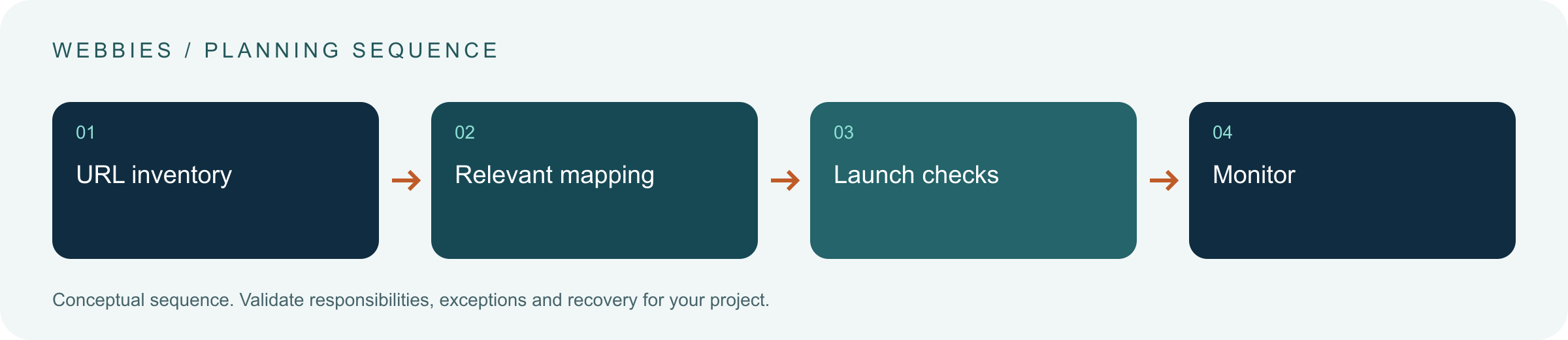
- Inventory current pages and useful search journeys.
- Approve content decisions and a relevant URL map.
- Test redirects, indexability, metadata and forms.
- Monitor discovery and resolve migration defects after launch.
Prepare a useful project brief
| Decision | What to establish |
|---|---|
| Audience | business teams planning a website rebuild |
| First boundary to agree | Inventory current pages and useful search journeys. |
| Evidence of useful performance | Track crawl errors, valid destinations, indexed-page patterns, search journeys and successful enquiries over an appropriate observation period. |
| Estimate dependency | URL volume, platform changes, content consolidation and available performance data drive migration effort. |
Bring sample inputs and an example of an exception to the first discussion. Separate confirmed requirements from assumptions, and identify who can supply missing information. The brief should let a delivery team explain what it needs to investigate before making a detailed commitment.
Common Mistakes to Avoid
- Redirecting all old pages to the homepage.
- Launching with staging indexing restrictions.
- Removing useful content because its template looks dated.
Frequently Asked Questions
What does website redesign SEO mean in a business project?
Website redesign SEO is the planning and verification of search-related content, URLs and technical behaviour during a website redesign or migration.
How should a team begin evaluating SEO website migration?
Inventory current pages and useful search journeys. Approve content decisions and a relevant URL map.
How do we measure whether redesign redirect plan is useful?
Track crawl errors, valid destinations, indexed-page patterns, search journeys and successful enquiries over an appropriate observation period.
What affects the cost or timeline of website redesign SEO?
URL volume, platform changes, content consolidation and available performance data drive migration effort. A delivery estimate should follow a review of these dependencies.
What is a common misconception about website redesign SEO?
A cleaner design does not automatically preserve search visibility; content and technical continuity need explicit work.
Conclusion
A redesign should carry useful discovery paths into the new experience. Plan content and URL continuity early, then monitor real customer and crawl behaviour after release. Plan a redesign with search continuity with Webbies.
Sources and further reading
- Google Search Central: Site moves with URL changes — primary technical reference, checked during research on 30 October 2026.
Discuss your project
Plan a redesign with search continuity. Share the current workflow, intended users, existing systems and the decision you need to make; the next step can be a 20–30 minute discovery discussion.