
Voice AI for Business: Plan Multilingual Service Workflows
TL;DR: Voice AI for business combines speech recognition, language understanding, business tools and speech output to support spoken workflows. Choose a narrow spoken task and define critical details. A human-sounding voice does not establish that the system understood the caller or completed the requested action.

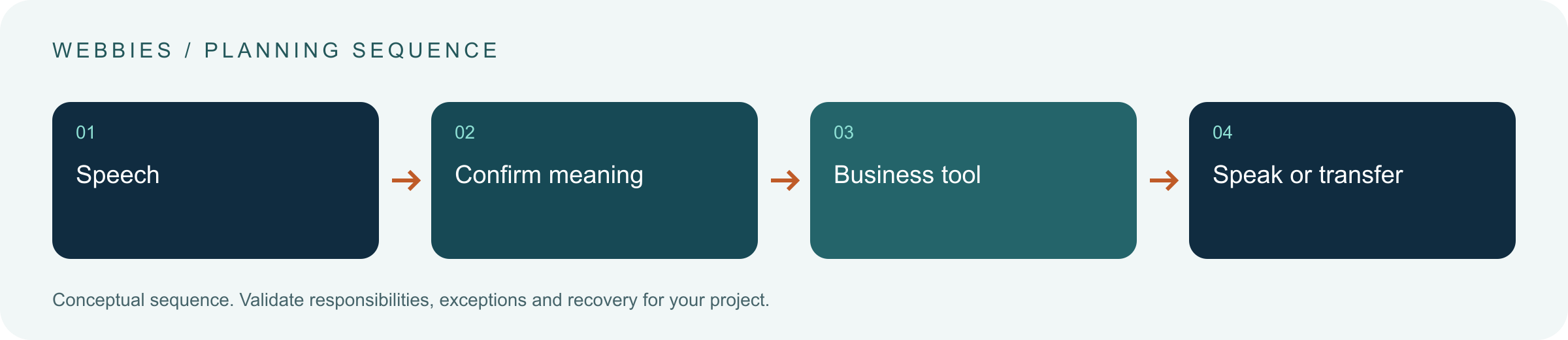
Original AI-generated editorial illustration; it depicts a concept rather than a client deployment or product screenshot.
Introduction
A spoken interface adds timing, background noise and interruption to the problems a text assistant already faces. A caller may switch languages, correct a reference number halfway through or ask for a person. Design those moments before deciding which voice sounds most natural in a demonstration. Here is how to evaluate voice AI for business against that business need.
What Is voice AI for business?
Voice AI for business combines speech recognition, language understanding, business tools and speech output to support spoken workflows.
Speech recognition errors can alter names, quantities and account identifiers. Callers need interruption, correction and human transfer options. Language coverage must be tested with the people and environments involved.
A human-sounding voice does not establish that the system understood the caller or completed the requested action. The scope should make this distinction clear before the team commits to a solution.
Technical context: Google documents language recognition with explicit supported-language and model constraints. Google Cloud: Multiple-language speech recognition
Why voice AI for business Matters
- Speech recognition errors can alter names, quantities and account identifiers.
- Callers need interruption, correction and human transfer options.
- Language coverage must be tested with the people and environments involved.
How to Evaluate and Implement voice AI for business
Define the conversation and its boundaries
Choose a task such as appointment enquiries or service-request intake rather than an open-ended phone representative. Decide what the system can confirm and what requires staff review. Ask for explicit confirmation of critical details in a form the caller can understand. Plan an alternative channel when audio quality is poor. A voice interface should reduce effort for its intended users, not force every interaction through speech.
Evaluate the whole spoken journey
Test with consented recordings or appropriately prepared test material covering accents, code-switching, noisy environments and interruptions. Measure whether the final business record is correct, not just whether individual words were transcribed accurately. Latency includes endpoint detection, tool calls and speech generation. Long pauses after a caller has supplied an identifier can make an otherwise accurate interaction feel broken. Provide clear progress cues and avoid speaking over the caller.
Connect identity, consent and handoff
Treat recordings and transcripts as governed business data. Decide what will be retained, who can access it and what notices the workflow requires with qualified local review. Authenticate users before revealing account information. A transfer should carry a concise, verified summary rather than the assistant's interpretation alone. When a call disconnects, preserve the difference between an enquiry received and a booking actually confirmed in the destination system.
Compare the available approaches
| Approach | Suitable starting point | Main limitation or responsibility |
|---|---|---|
| Voice menu | Small fixed set of choices | Limited flexibility |
| Voice assistant | Variable spoken questions | Needs language and interruption testing |
| Staff-supported voice intake | Structured information plus human follow-up | Requires a clear queue owner |
A practical example
Imagine a Kathmandu hospitality business testing a multilingual enquiry assistant. It can collect travel dates, explain approved property information and request a staff callback. It does not promise room availability until the booking system confirms it. Tests include street noise, mixed-language questions and a caller changing dates during the conversation. The pilot's value is judged by correct enquiries and effective handoffs; the business has not yet authorised autonomous bookings.
An acceptance test worth running
Test a caller who changes an identifier halfway through a noisy, mixed-language enquiry. The system should confirm the corrected value and avoid creating a second request. Interrupt a spoken response, then disconnect before final confirmation. Check the resulting business record and the staff handoff. The test should evaluate understanding and completion rather than how pleasant the selected voice sounds.
What to measure
Track task completion, critical-field errors, response latency, successful transfers and caller correction effort by language and environment.
Use a representative baseline and record the conditions of the comparison. Agree who reviews failures and what evidence is needed before expanding the scope. For a broader view of the related delivery work, explore Webbies services.
Practical Steps for voice AI for business
- Choose a narrow spoken task and define critical details.
- Prepare language and acoustic test cases with suitable consent.
- Build confirmation, interruption and transfer behaviour.
- Evaluate final records and call recovery before widening the task.
Prepare a useful project brief
| Decision | What to establish |
|---|---|
| Audience | operations leaders evaluating spoken service interactions |
| First boundary to agree | Choose a narrow spoken task and define critical details. |
| Evidence of useful performance | Track task completion, critical-field errors, response latency, successful transfers and caller correction effort by language and environment. |
| Estimate dependency | Telephony, concurrency, language testing, transcription, synthesis, integrations and recording retention affect the operating budget. |
Bring sample inputs and an example of an exception to the first discussion. Separate confirmed requirements from assumptions, and identify who can supply missing information. The brief should let a delivery team explain what it needs to investigate before making a detailed commitment.
Common Mistakes to Avoid
- Assuming one clean recording proves language suitability.
- Reading long text-style answers aloud.
- Calling an enquiry complete when the destination never received it.
Frequently Asked Questions
What does voice AI for business mean in a business project?
Voice AI for business combines speech recognition, language understanding, business tools and speech output to support spoken workflows.
How should a team begin evaluating multilingual voice assistant?
Choose a narrow spoken task and define critical details. Prepare language and acoustic test cases with suitable consent.
How do we measure whether voice agent integration is useful?
Track task completion, critical-field errors, response latency, successful transfers and caller correction effort by language and environment.
What affects the cost or timeline of voice AI for business?
Telephony, concurrency, language testing, transcription, synthesis, integrations and recording retention affect the operating budget. A delivery estimate should follow a review of these dependencies.
What is a common misconception about voice AI for business?
A human-sounding voice does not establish that the system understood the caller or completed the requested action.
Conclusion
A spoken service succeeds when it understands, confirms and completes the task under real acoustic conditions. Natural delivery cannot replace reliable records and handoffs. Assess a multilingual voice workflow with Webbies.
Sources and further reading
- Google Cloud: Multiple-language speech recognition — primary technical reference, checked during research on 30 October 2026.
Discuss your project
Assess a multilingual voice workflow. Share the current workflow, intended users, existing systems and the decision you need to make; the next step can be a 20–30 minute discovery discussion.