Legacy Modernization: Replace Risky Systems in Manageable Steps
TL;DR: Legacy modernization is the progressive improvement or replacement of an existing application's architecture, technology or operating model to address defined business constraints. Map workflows, data ownership and hidden dependencies. Modernization does not require replacing every part at once; targeted changes can be more controllable.
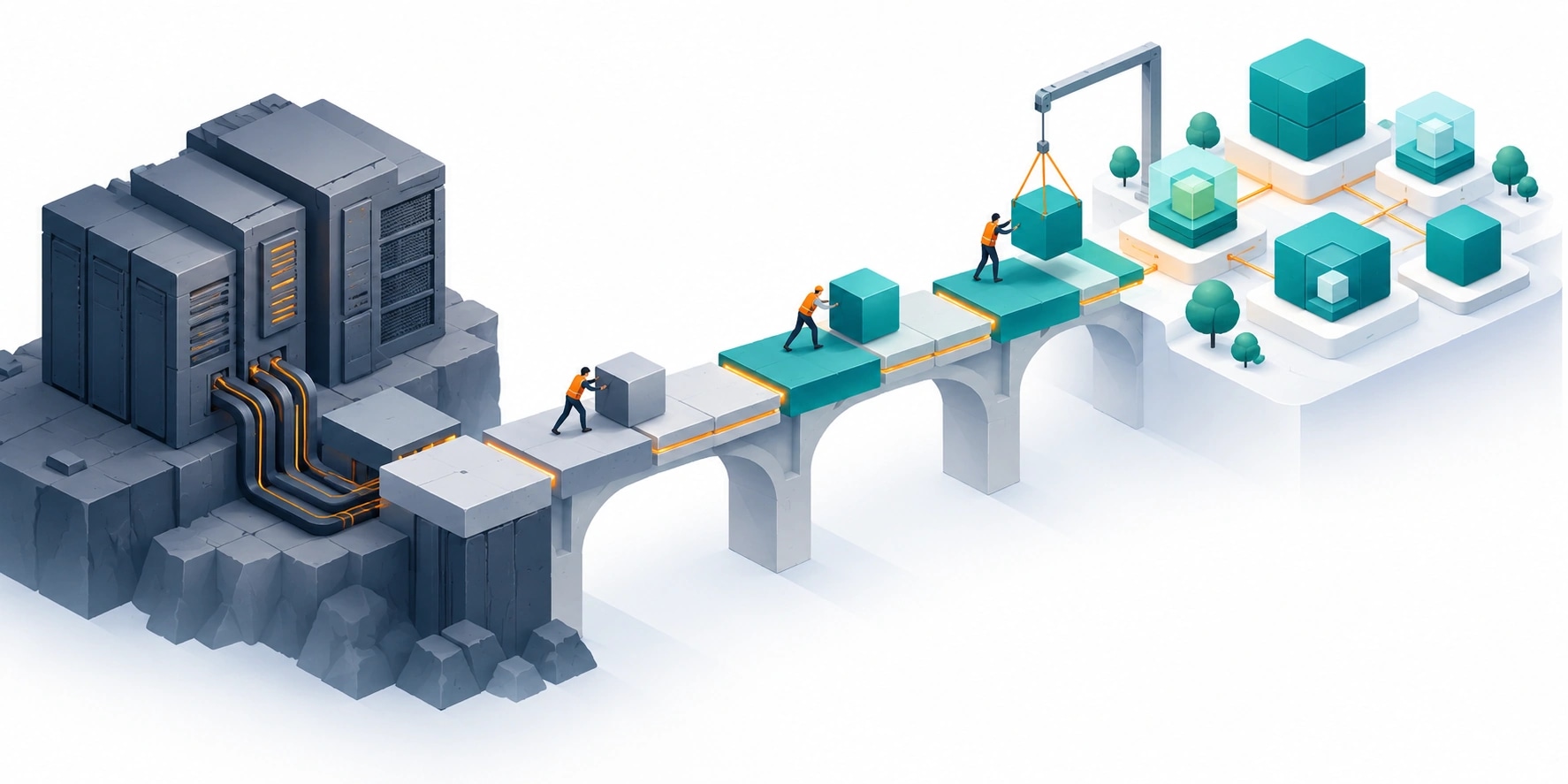
Original AI-generated editorial illustration; it depicts a concept rather than a client deployment or product screenshot.
Introduction
An old system can be difficult to change and still contain years of essential business knowledge. Replacing it safely requires understanding both the code and the work people rely on. A phased plan should reduce a specific risk while preserving a way to keep the business operating. Here is how to evaluate legacy modernization against that business need.
What Is legacy modernization?
Legacy modernization is the progressive improvement or replacement of an existing application's architecture, technology or operating model to address defined business constraints.
Undocumented rules often live inside old workflows. A full replacement can concentrate migration and continuity risk. Modern technology alone does not resolve unclear data ownership.
Modernization does not require replacing every part at once; targeted changes can be more controllable. The scope should make this distinction clear before the team commits to a solution.
Technical context: AWS describes incremental replacement through the strangler fig pattern. AWS: Strangler fig modernization pattern
Why legacy modernization Matters
- Undocumented rules often live inside old workflows.
- A full replacement can concentrate migration and continuity risk.
- Modern technology alone does not resolve unclear data ownership.
How to Evaluate and Implement legacy modernization
Inventory behaviour and dependencies
Map users, business processes, data stores and external interfaces. Record batch jobs, exports and unofficial spreadsheets that depend on the system. Ask operators about month-end activity and rare exceptions. A code inventory is useful but incomplete if it misses those operating dependencies. Prioritise the parts causing measurable change delays, support incidents or security exposure rather than rewriting every component for consistency.
Choose a bounded replacement seam
A new interface, reporting capability or isolated business service may be a safer starting point than the central transaction engine. Define how old and new components exchange data and which system owns each field during transition. Use an adapter or routing layer where appropriate. Keep the initial boundary small enough to test and reverse. Incremental replacement still needs a coherent target architecture to avoid permanent duplicate systems.
Rehearse data and operational cutover
Validate migration rules, record counts and business totals. Test historical records and active transactions separately. Prepare reconciliation, rollback and a support rota for the transition. Run parallel checks where they provide meaningful evidence, while recognising that parallel operation creates its own workload. Decommission obsolete paths deliberately after the new component is accepted; otherwise the business inherits two maintenance obligations.
Compare the available approaches
| Approach | Suitable starting point | Main limitation or responsibility |
|---|---|---|
| Rehost | Move the existing application environment | Limited change to business behaviour |
| Refactor incrementally | Improve or replace bounded components | Needs clear transition ownership |
| Full replacement | Move to a new system | Concentrates cutover and migration risk |
A practical example
A hypothetical manufacturer replaces an ageing dealer interface while retaining the ERP as the order authority. The first stage modernises account access and status visibility. New order submission is introduced after interface and reconciliation tests pass. Historical data remains accessible through a controlled path. The project reduces one operational problem at a time rather than claiming that a new front end has modernised the entire enterprise.
An acceptance test worth running
Rehearse migration with active and historical records, then simulate a failed cutover. Confirm reconciliation and the criteria for reverting to the previous path. Have operators complete an infrequent but important process in the new component. Capture undocumented rules discovered during rehearsal and resolve them with business owners before they become defects in the replacement system.
What to measure
Track continuity, migration correctness, incident load, change lead time and retirement of obsolete components.
Use a representative baseline and record the conditions of the comparison. Agree who reviews failures and what evidence is needed before expanding the scope. For a broader view of the related delivery work, explore Webbies services.
Practical Steps for legacy modernization
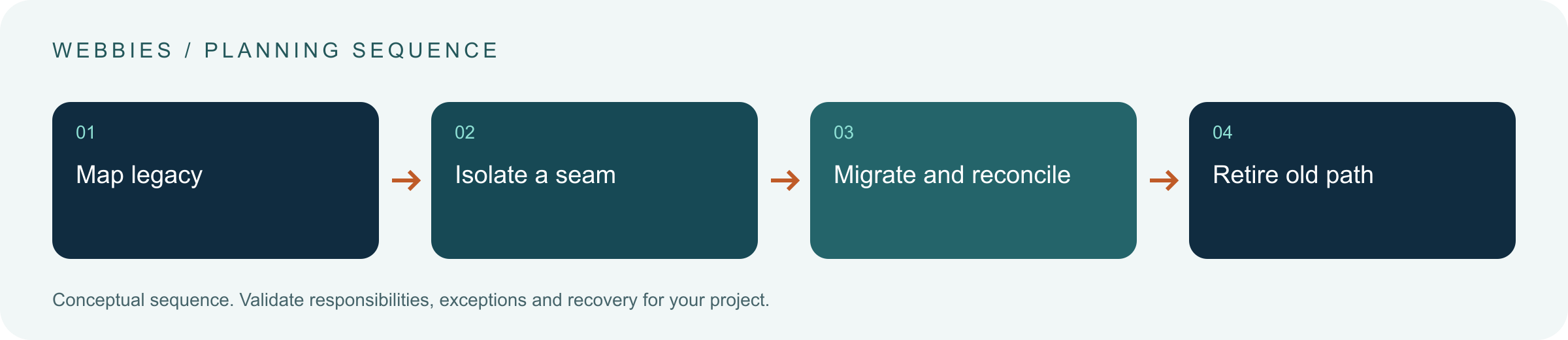
- Map workflows, data ownership and hidden dependencies.
- Choose a high-value, testable replacement boundary.
- Rehearse migration and reconcile business records.
- Cut over with rollback criteria and retire the replaced path.
Prepare a useful project brief
| Decision | What to establish |
|---|---|
| Audience | IT leaders replacing business-critical legacy applications |
| First boundary to agree | Map workflows, data ownership and hidden dependencies. |
| Evidence of useful performance | Track continuity, migration correctness, incident load, change lead time and retirement of obsolete components. |
| Estimate dependency | Dependency uncertainty, data quality, business continuity demands and migration rehearsal drive scope. |
Bring sample inputs and an example of an exception to the first discussion. Separate confirmed requirements from assumptions, and identify who can supply missing information. The brief should let a delivery team explain what it needs to investigate before making a detailed commitment.
Common Mistakes to Avoid
- Rewriting undocumented rules without domain review.
- Leaving two systems able to alter the same record freely.
- Planning migration only after the new interface is finished.
Frequently Asked Questions
What does legacy modernization mean in a business project?
Legacy modernization is the progressive improvement or replacement of an existing application's architecture, technology or operating model to address defined business constraints.
How should a team begin evaluating legacy application modernization?
Map workflows, data ownership and hidden dependencies. Choose a high-value, testable replacement boundary.
How do we measure whether incremental software replacement is useful?
Track continuity, migration correctness, incident load, change lead time and retirement of obsolete components.
What affects the cost or timeline of legacy modernization?
Dependency uncertainty, data quality, business continuity demands and migration rehearsal drive scope. A delivery estimate should follow a review of these dependencies.
What is a common misconception about legacy modernization?
Modernization does not require replacing every part at once; targeted changes can be more controllable.
Conclusion
Modernization should reduce an identified business risk while preserving continuity. Replace a testable boundary, reconcile the data and retire the obsolete path deliberately. Review a phased modernization roadmap with Webbies.
Sources and further reading
- AWS: Strangler fig modernization pattern — primary technical reference, checked during research on 30 October 2026.
Discuss your project
Review a phased modernization roadmap. Share the current workflow, intended users, existing systems and the decision you need to make; the next step can be a 20–30 minute discovery discussion.