Custom Software vs SaaS: Make a Build-or-Buy Decision
TL;DR: Custom software vs SaaS is a build-or-buy decision between a tailored application and a subscribed software product operated by a provider. Document outcomes, exceptions and negotiable requirements. Build or buy is not always a binary choice; a standard platform with a well-designed custom layer can fit best.

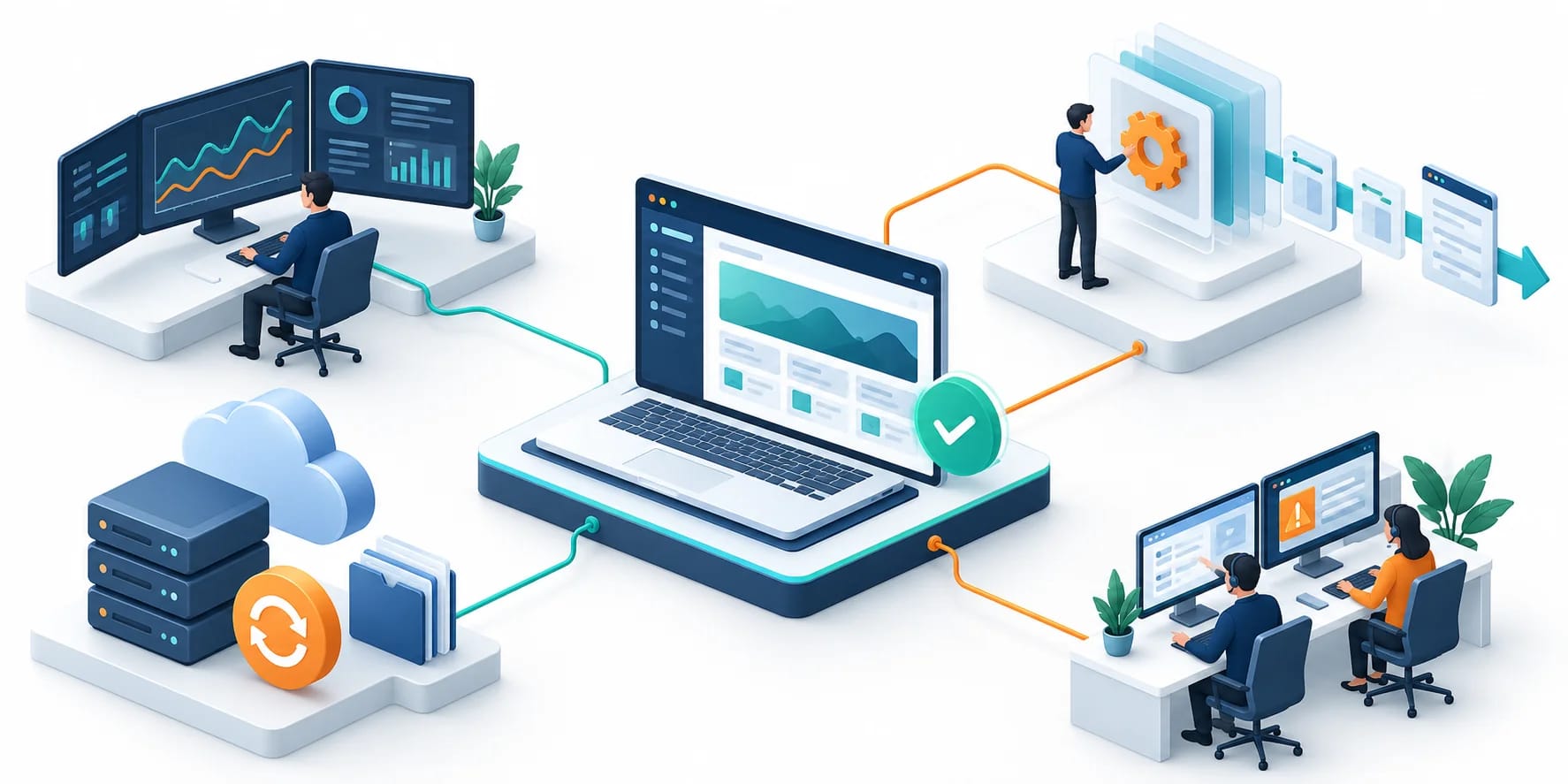
Original AI-generated editorial illustration; it depicts a concept rather than a client deployment or product screenshot.
Introduction
A subscription can become expensive when staff work around it all day. Custom software can become expensive when a business rebuilds capabilities that an established product already supplies. Compare the operating process and the consequences of each choice, including the work needed after the first release. Here is how to evaluate custom software vs SaaS against that business need.
What Is custom software vs SaaS?
Custom software vs SaaS is a build-or-buy decision between a tailored application and a subscribed software product operated by a provider.
Process fit affects adoption and manual workarounds. Data portability and integrations shape future flexibility. A purchase price does not represent total ownership cost.
Build or buy is not always a binary choice; a standard platform with a well-designed custom layer can fit best. The scope should make this distinction clear before the team commits to a solution.
Technical context: AWS describes incremental replacement through the strangler fig pattern. AWS: Strangler fig modernization pattern
Why custom software vs SaaS Matters
- Process fit affects adoption and manual workarounds.
- Data portability and integrations shape future flexibility.
- A purchase price does not represent total ownership cost.
How to Evaluate and Implement custom software vs SaaS
Separate standard needs from differentiating workflows
List required outcomes and mark where the process can adapt to a product. Standard accounting or common collaboration needs may not justify a custom build. Unique commercial rules, complex integrations or a customer-facing product may need tailored engineering. Challenge every claimed requirement: some reflect historical habits rather than a real constraint. The best answer can be a standard product connected to a smaller custom layer.
Compare lifecycle costs and responsibility
For SaaS, examine licences, usage limits, implementation, integrations and exit effort. For custom software, include discovery, engineering, hosting, support, security updates and staff ownership. Compare the same scope and service expectations. A custom system gives flexibility only if the business can fund and govern its evolution. A SaaS product provides convenience only if its capabilities and contractual constraints fit the intended workflow.
Test the difficult cases before committing
Run representative scenarios involving exceptions, permissions and data export. Ask what happens when a supplier changes an API or a business rule changes. Confirm who owns custom connectors and how data can be recovered in a usable format. Review a proposed migration path before making a large commitment. A demonstration of the happy path is insufficient for either a product purchase or a development proposal.
Compare the available approaches
| Approach | Suitable starting point | Main limitation or responsibility |
|---|---|---|
| SaaS | Standard capabilities and provider operation | Configuration limits and recurring terms |
| Custom application | Distinctive workflows and product control | Engineering and maintenance responsibility |
| Hybrid | Standard core plus tailored integration | Boundary and connector ownership |
A practical example
A hypothetical multi-branch wholesaler retains standard accounting software but needs dealer-specific ordering rules. Replacing the accounting system would add unnecessary risk. A tailored portal connected to the existing product becomes one candidate, compared against SaaS platforms with equivalent account and pricing support. The decision rests on fit, integration and ownership, rather than a blanket preference for custom development.
An acceptance test worth running
Run the same difficult order and data-export scenarios in candidate SaaS products and a proposed custom approach. Record configuration, manual work and missing capabilities. Ask who maintains each connector and how the business could leave the arrangement. Compare the operating process, not just the demonstration. A standard product with a narrow custom layer should remain an explicit candidate where it fits.
What to measure
Compare workflow completion, workaround effort, integration reliability, change lead time and total operating responsibility.
Use a representative baseline and record the conditions of the comparison. Agree who reviews failures and what evidence is needed before expanding the scope. For a broader view of the related delivery work, explore Webbies services.
Practical Steps for custom software vs SaaS
- Document outcomes, exceptions and negotiable requirements.
- Test suitable products against representative scenarios.
- Compare lifecycle costs, responsibilities and exit options.
- Choose the approach with the strongest fit and maintainable ownership.
Prepare a useful project brief
| Decision | What to establish |
|---|---|
| Audience | business and technology leaders making a software investment |
| First boundary to agree | Document outcomes, exceptions and negotiable requirements. |
| Evidence of useful performance | Compare workflow completion, workaround effort, integration reliability, change lead time and total operating responsibility. |
| Estimate dependency | User counts, licence structure, process uniqueness, integrations and support obligations shape the comparison. |
Bring sample inputs and an example of an exception to the first discussion. Separate confirmed requirements from assumptions, and identify who can supply missing information. The brief should let a delivery team explain what it needs to investigate before making a detailed commitment.
Common Mistakes to Avoid
- Comparing subscription fees with only the custom build quote.
- Assuming custom code automatically creates strategic value.
- Ignoring data export and supplier change risk.
Frequently Asked Questions
What does custom software vs SaaS mean in a business project?
Custom software vs SaaS is a build-or-buy decision between a tailored application and a subscribed software product operated by a provider.
How should a team begin evaluating build vs buy software?
Document outcomes, exceptions and negotiable requirements. Test suitable products against representative scenarios.
How do we measure whether bespoke software decision is useful?
Compare workflow completion, workaround effort, integration reliability, change lead time and total operating responsibility.
What affects the cost or timeline of custom software vs SaaS?
User counts, licence structure, process uniqueness, integrations and support obligations shape the comparison. A delivery estimate should follow a review of these dependencies.
What is a common misconception about custom software vs SaaS?
Build or buy is not always a binary choice; a standard platform with a well-designed custom layer can fit best.
Conclusion
Build-or-buy decisions improve when process fit and lifecycle ownership are compared together. A standard core with a tailored layer deserves consideration alongside either extreme. Assess a build-or-buy decision with Webbies.
Sources and further reading
- AWS: Strangler fig modernization pattern — primary technical reference, checked during research on 30 October 2026.
Discuss your project
Assess a build-or-buy decision. Share the current workflow, intended users, existing systems and the decision you need to make; the next step can be a 20–30 minute discovery discussion.