
Mobile App MVP: Choose a First Release That Tests the Business
TL;DR: A mobile app MVP is a focused first product release designed to test a business hypothesis through a usable end-to-end mobile journey. State one user, problem and measurable hypothesis. Minimum scope does not mean minimum reliability for the journey the product promises to support.
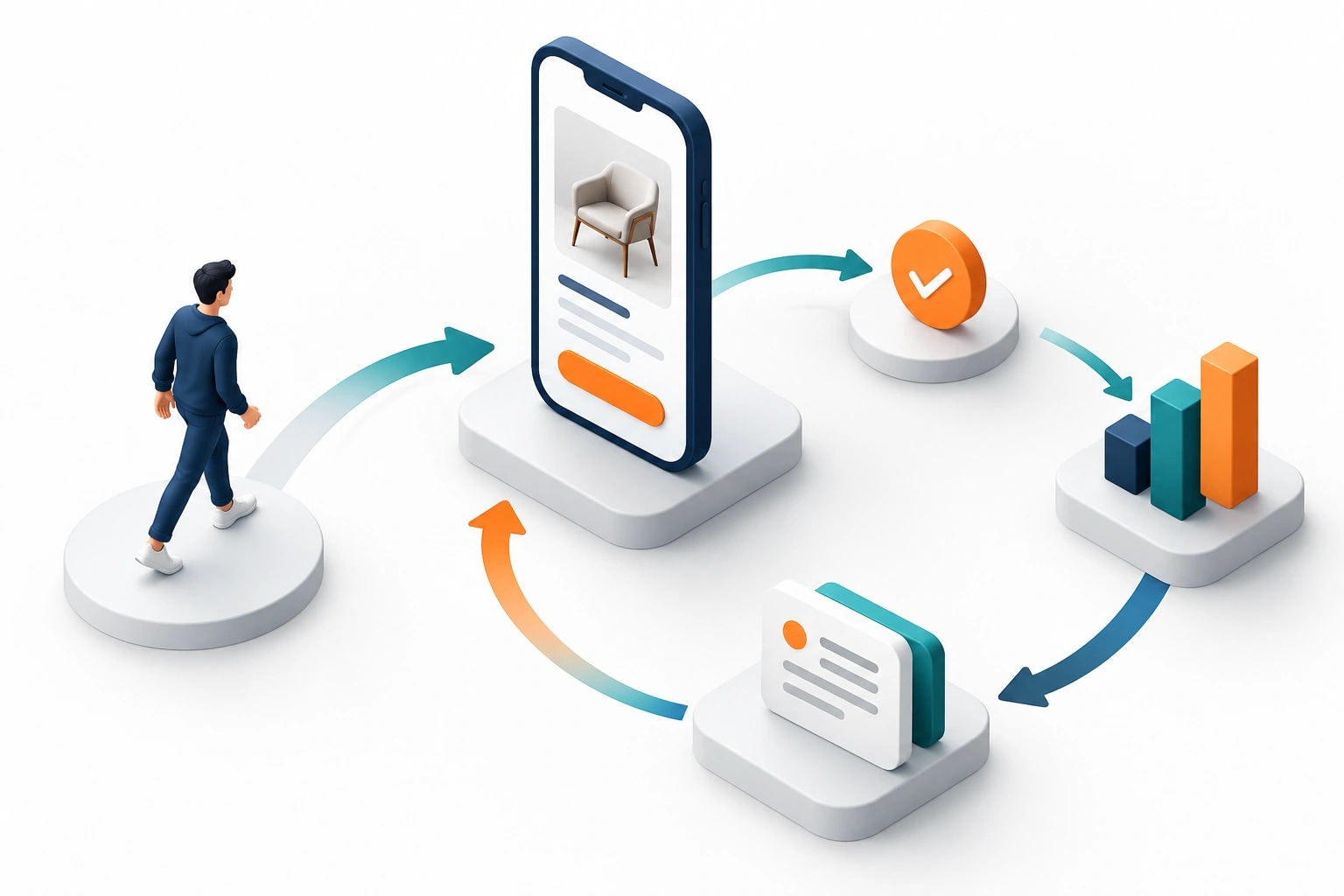
Original AI-generated editorial illustration; it depicts a concept rather than a client deployment or product screenshot.
Introduction
A first app release should test a clear business assumption. A long feature list can delay that learning while making failures harder to interpret. Focus on one end-to-end journey that a real user can complete, including the operational work required after the user taps the final button. Here is how to evaluate mobile app MVP against that business need.
What Is mobile app MVP?
A mobile app MVP is a focused first product release designed to test a business hypothesis through a usable end-to-end mobile journey.
Disconnected features do not establish that the core journey works. Back-office handling can determine whether the customer receives value. An explicit hypothesis makes the next investment easier to decide.
Minimum scope does not mean minimum reliability for the journey the product promises to support. The scope should make this distinction clear before the team commits to a solution.
Technical context: The Service Manual describes testing risky assumptions before committing to wider delivery. GOV.UK: Working in alpha
Why mobile app MVP Matters
- Disconnected features do not establish that the core journey works.
- Back-office handling can determine whether the customer receives value.
- An explicit hypothesis makes the next investment easier to decide.
How to Evaluate and Implement mobile app MVP
Choose the learning goal
Write the question the release must answer: will customers repeat a particular ordering task, or can staff complete a visit without rekeying? Define the user group and the evidence that would support the hypothesis. Avoid using downloads as the only indicator. A user who installs the app but cannot finish setup contributes little evidence about the proposed business value.
Deliver one complete journey
Include identity, essential input, the core action, confirmation and a recovery path. A smaller journey should still be dependable. Manual back-office steps can be acceptable when they are explicit, staffed and measurable. Document where manual handling occurs so it is not mistaken for completed automation. Exclude adjacent features that do not resolve the initial uncertainty, even if they would make the demonstration appear broader.
Prepare operations and measurement
Name who handles failed transactions, account issues and user feedback. Instrument meaningful events rather than every screen tap. Define a review point and the decisions that follow the evidence. Maintenance, store distribution and privacy-related implementation still need attention in an MVP. A learning release is a real application used by people, so abandoned requests and broken recovery remain product failures.
Compare the available approaches
| Approach | Suitable starting point | Main limitation or responsibility |
|---|---|---|
| Prototype | Explore understanding and interaction | May not perform live business work |
| MVP | Test one usable business journey | Needs real operational support |
| Broad first release | Serve many needs immediately | Makes learning and delivery harder |
A practical example
A hypothetical B2B startup tests recurring replenishment orders for a small customer group. The first release supports a maintained catalogue, order creation and a confirmed fulfilment status. Recommendations, loyalty points and complex analytics are deferred. The founder reviews successful repeat orders and operational exceptions before deciding which feature would improve the validated workflow. The example gives no promised launch timeline or adoption result.
An acceptance test worth running
Invite a representative user with no prepared account data. Observe whether the person can complete the core journey and whether staff can fulfil the resulting request. Remove an optional feature and repeat the task. If the business hypothesis can still be tested, the feature may belong later. Keep the failure and support route in the minimum release rather than deferring them as polish.
What to measure
Track activation, first successful task, repeat use, failed journeys and the manual effort required to serve each user.
Use a representative baseline and record the conditions of the comparison. Agree who reviews failures and what evidence is needed before expanding the scope. For a broader view of the related delivery work, explore Webbies services.
Practical Steps for mobile app MVP
- State one user, problem and measurable hypothesis.
- Map the complete journey and its manual dependencies.
- Define essential recovery and support responsibilities.
- Review task outcomes before approving the next feature group.
Prepare a useful project brief
| Decision | What to establish |
|---|---|
| Audience | founders and product owners preparing a first mobile release |
| First boundary to agree | State one user, problem and measurable hypothesis. |
| Evidence of useful performance | Track activation, first successful task, repeat use, failed journeys and the manual effort required to serve each user. |
| Estimate dependency | The core transaction, integrations, supported platforms and operational obligations determine scope more than screen count. |
Bring sample inputs and an example of an exception to the first discussion. Separate confirmed requirements from assumptions, and identify who can supply missing information. The brief should let a delivery team explain what it needs to investigate before making a detailed commitment.
Common Mistakes to Avoid
- Calling a collection of unfinished features an MVP.
- Omitting the operational team from scope decisions.
- Treating acquisition metrics as proof of repeat value.
Frequently Asked Questions
What does mobile app MVP mean in a business project?
A mobile app MVP is a focused first product release designed to test a business hypothesis through a usable end-to-end mobile journey.
How should a team begin evaluating minimum viable mobile product?
State one user, problem and measurable hypothesis. Map the complete journey and its manual dependencies.
How do we measure whether app MVP scope is useful?
Track activation, first successful task, repeat use, failed journeys and the manual effort required to serve each user.
What affects the cost or timeline of mobile app MVP?
The core transaction, integrations, supported platforms and operational obligations determine scope more than screen count. A delivery estimate should follow a review of these dependencies.
What is a common misconception about mobile app MVP?
Minimum scope does not mean minimum reliability for the journey the product promises to support.
Conclusion
A focused MVP makes one useful journey work and produces evidence for the next decision. Keep support and recovery inside that journey from the beginning. Define a focused mobile MVP with Webbies.
Sources and further reading
- GOV.UK: Working in alpha — primary technical reference, checked during research on 30 October 2026.
Discuss your project
Define a focused mobile MVP. Share the current workflow, intended users, existing systems and the decision you need to make; the next step can be a 20–30 minute discovery discussion.