Case study Experiences
All case studiesBody Movement Projection — Case Study
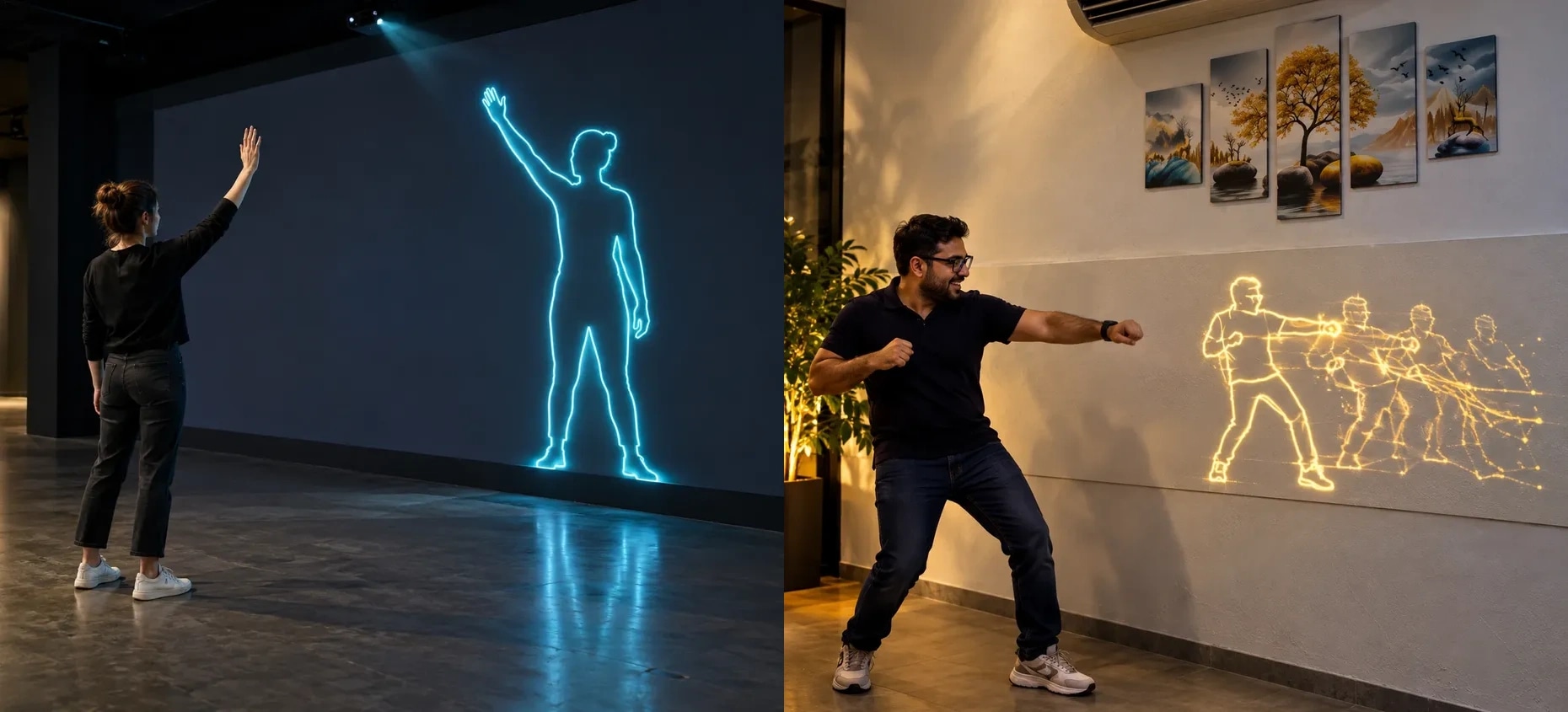
An interactive body movement projection concept that uses pose tracking to translate human motion into luminous line-art visuals within a physical space.
Overview
Webbies conceptualised a body movement projection system in which human movement becomes part of a visual experience. Pose tracking connects a participant’s movement with luminous line-art imagery projected into the surrounding space.
Context and Challenge
An interactive installation needs a clear connection between a participant’s movement and the visual response. This concept explores that relationship by making the body itself an input to the experience.
Solution
Webbies conceptualised a pose-tracking system that translates movement into luminous line-art visuals. Body tracking, movement recognition and dynamic effects connect the participant with a projected response in the surrounding space.
The Outcome
The work is presented as a concept and demonstration of movement-driven visuals. It illustrates the interaction without asserting a particular camera, pose-estimation framework or installation specification.
The Impact
The demonstration makes a participatory interaction tangible: moving changes the visual experience. It provides a direction for immersive installations, without claiming measured latency, commercial deployment or visitor outcomes.
Features
Track the participant’s pose
Body-pose tracking provides the connection between physical movement and the digital response. It is the documented input to the concept’s visual interaction.
Translate motion into visual form
Movement recognition and dynamic effects turn the participant’s actions into changing line-art imagery. The experience makes motion visible through the projected response.
Bring the response into the room
Projection locates the imagery on a physical surface. The person and the visual output occupy the same setting, making the surrounding space part of the interaction.
Describe the demonstrated scope
The presentation explains the intended real-time relationship without claiming tested latency, venue readiness or a particular sensing system. Those details require implementation evidence.
Explore further
Let’s make a start
Tell us what
you have in mind.
Choose a service to start the conversation.
Continue with AI development & generative AI